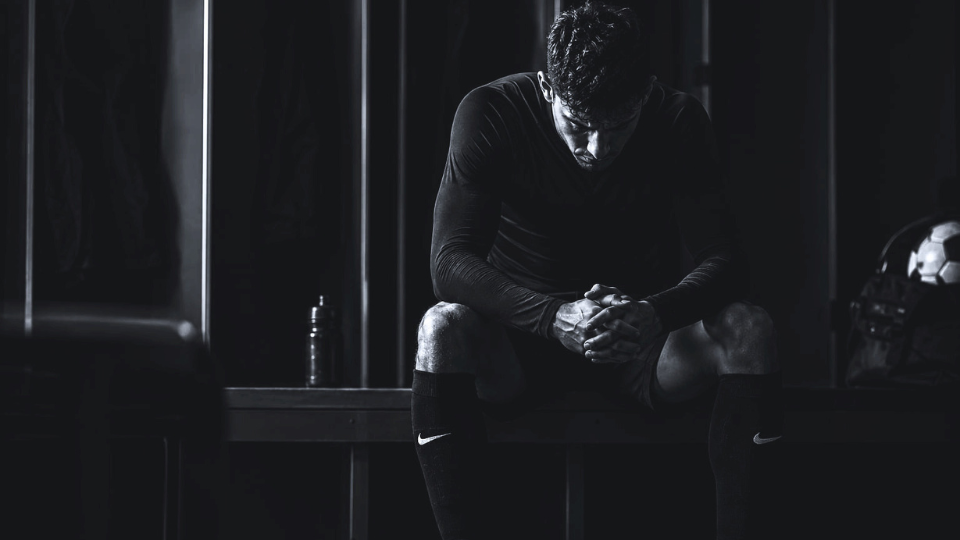
I want to start with a story. I had a player message me last season after a game he'd actually played well in. He started and played ninety minutes. In his own words: "I played good and made no mistakes." But then he said something that made me rethink high performance. He added: "I don't know why I still feel like that afterwards." He couldn't even explain what "that" was properly. When I asked him what exactly he meant, he said football feels heavy these days and he feels kind of off.
That made me pause. I thought about what he said for the next couple of days.
A few days later it hit me, when I heard someone say:
If we truly have nothing to lose, we can act and perform freely. But is that ever really the case? Maybe at the beginning of your career it is. It certainly was when you started out playing football and your only "why" was that you enjoyed kicking a ball around, and it made you dream about what you could become one day. No fear of losing anything back then. Just anticipation of what's coming if you keep improving, keep growing, keep learning.
But once you reach a certain point in your career, there are things on the line - like your starting position or your next contract or your sponsorship deal. And probably the biggest one - your reputation is on the line every time you make a mistake - or at least so it feels.
So it's natural to stop playing free, right? Nobody plays free at a certain level - or do they?
False.
There are players who play with total freedom. Players who don't seem to care if they lose the ball, who never look afraid of losing anything, because they're not playing not to lose, they're playing to win and to express who they truly are. And it shows. It's the difference between a player who's technically good and a player who makes a stadium stand up.
Think of Ronaldinho against Real Madrid at the Bernabeu, November 19, 2005. Barcelona won 3-0 away from home, Ronaldinho scored twice, and by the time he scored his second, the Real Madrid crowd, the actual home fans of the team he'd just torn apart, stood up and applauded him. Think about that. The opposition's own supporters gave a standing ovation to the man beating their team. That doesn't happen because of a good final ball completion rate. It happens because everyone in that stadium could feel he was playing with zero fear of losing the ball, dancing through challenges purely because he could, purely to express himself and what was in him.
Or think of Messi and Neymar. Both of them will attempt the impossible pass or the one-on-one dribble in a tight game, knowing full well they might lose the ball more than a safer player would. And they actually lose the ball more often than others if you look at their stats, but they do it anyway. Not because they don't care about the result, but because playing safe was never the point for them.
That's what football actually is, when you strip everything else away - it is entertainment. And the players who go down in history, who get the biggest contracts and the biggest paychecks, aren't the ones who protected their reputation the hardest. They're the ones who played free. The real difference makers can only be difference makers because freedom is what they're playing with in the first place.
Now, I know what you might be thinking. Messi, Ronaldinho, Neymar, those are once-in-a-generation talents. Maybe freedom comes easy when you're that gifted, and it's a different conversation for the rest of us. I'd push back on that. Their talent is rare. What isn't rare is the open hand they play with. That part isn't reserved for once-in-a-generation feet, it's available to anyone willing to actually work on it, same as any other part of the game. You don't need Messi's talent to approach the game with a metaphorical open hand instead of a closed fist. You just need to understand what closed it in the first place.
An open hand just means letting things happen - it’s the feeling you have when you enter flow states, when everything seems easy and effortless and where you can give it your all without ever getting tired of it. On the contrary when you play with a tightly closed fist, it is as if you are trying to protect something out of fear of losing it. Both players might look similar from the outside in terms of effort they put in, same hours, but inside both players feel completely different.
Just hypothetically: how would you play if you had nothing to lose? If you weren't afraid to make a mistake.
... Write down how this version of you would play the game and what would be possible for you in the future. And then also write down what it costs you in the long run if you don't play with full freedom every training and every game...
Maybe you already want to stop reading right there and simply do that journaling exercise.
If you continue reading let me explain how you can spot the difference between a player who plays with an open hand or a closed fist and what's actually going on with a player who's lost his freedom on the pitch.
A researcher named Robert Vallerand studied passion and found it splits into two kinds that look identical from the outside, but run on completely different fuel underneath.
Picture two players on the same academy team, both staying late after training every day to work on free kicks. One of them is out there because he loves the exact feeling of the ball hitting the top corner. The other one is out there because if he keeps missing, it means something's wrong with him. Same reps, same sweat, same hours. But one of them is doing it out of love, the other one out of fear.
That's the actual split. Playing out of love, or harmonious passion, is freely chosen and sits in harmony with the rest of who you are - you have it, it doesn't have you. Obsessive passion, or out of fear, looks the same on a highlight reel, but it got internalized under pressure somewhere along the way, and your sense of worth quietly attached itself to it. You don't feel like you get to play anymore. You feel like you have to or else.
Ronaldinho danced through three defenders in a Clasico with the same freedom he probably had as a kid on the street in Porto Alegre, because losing the ball never threatened anything except the scoreline. That's what an open hand looks like. My player's grip had gone from open to closed somewhere in the years between his first touch and his ninetieth professional minute, without him ever noticing the shift.
What started out as playing to win became playing not to lose. Maybe also because football took up too much space for him personally and he feared losing it more than loving the process and trusting the universe. But maybe also because at some point playing the game stopped being fully his and started being something he had to protect in order to feel valuable, to feel seen, to get praise etc. All things we would call external motivators.
This isn't unique to football. The more we have, the more we fear losing it. What used to be a dream turns into something that costs us sleep, because we worry so much about losing it again. Energetically, it blocks flow states.
And on top of it all it becomes an exhausting way to live. Eventually it shows up on the pitch as hesitation, or overthinking that turns into over-passing - the simple pass instead of the long ball you know you have in you, because the risk of failure feels bigger than the chance of success.
So that's the real question, and it's a bigger one than talent, tactics, or even mentality in the usual sense. It's about whether you're holding the game, or the game is holding you. My player's grip had closed somewhere along the way, without him even noticing it happen. And once I understood that, the next question became obvious: where does that grip actually start tightening, and what does it look like once it does, on the pass a player doesn't take, in his own body under pressure, in the years that built the pattern in the first place?
That's exactly where part two picks up - Where the Grip Tightens, the rest of what I learned working through this with him, session by session.
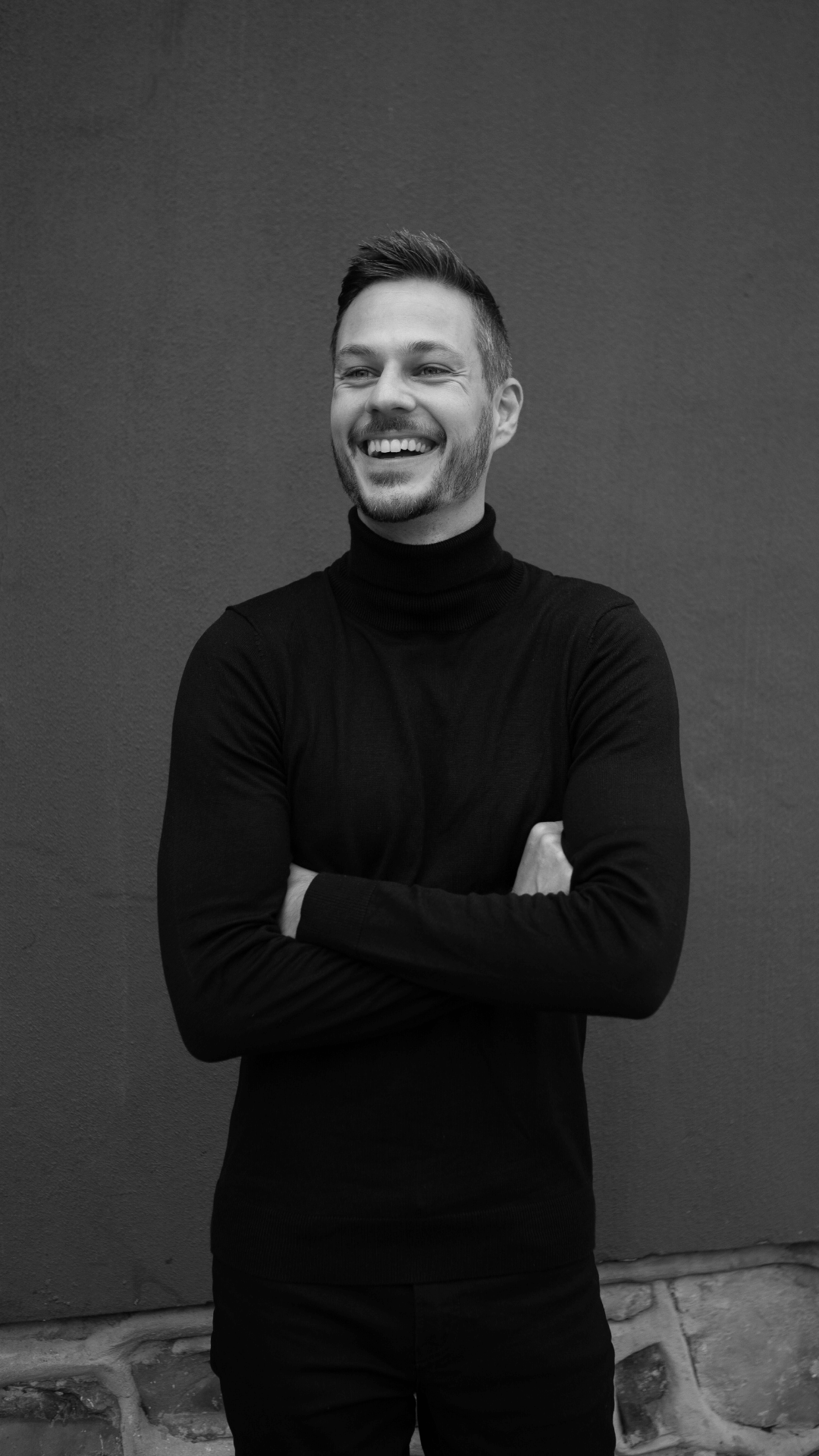
STEFAN PETER - THE HEAD COACH & AUTHOR
I'm Stefan Peter - mental performance coach for professional soccer player/footballers.
I got scouted by Manchester United as a kid. At 17 I had my pro trial with Leyton Orient - and froze. Not because I lacked talent. Because nobody had ever taught me what to do with my own head under that kind of pressure.
That moment built everything I do today.
I work with pro players and coaches on the layer of the game most coaching never addresses - nervous system control, subconscious autopilot patterns, and a personalised mental gameplan built around how you are specifically wired as a footballer.
Not generic mindset tips. The work that actually changes what happens on matchday.
Trained in High Performance Sport Psychology at FC Barcelona · MAS in Sports Health and Leadership · Advanced Breathwork Coach

More articles

STEFAN PETER - THE HEAD COACH
Working with players and coaches at FC Bayern München Women's · Gotham FC · Bournemouth FC
© Copyright 2026 - All rights reserved | Stefan Peter Coaching LLC
office@stefanpetercoaching.com